One Game, Infinite Lessons

From planning to perseverance, chess cultivates cognitive growth and life-ready skills in young learners.

In this article, you can explore:
✅ The rise of a thinking culture through chess
✅ Backed by science: What the brain gains from chess
✅ D. Gukesh: A mind trained early
✅ Moves that matter: How chess is powering progress
✅ A Guinness moment: India’s chess record
✅ Inclusivity on the chessboard
✅ Chess and the classroom: Where learning deepens
✅ Skills that students build through chess
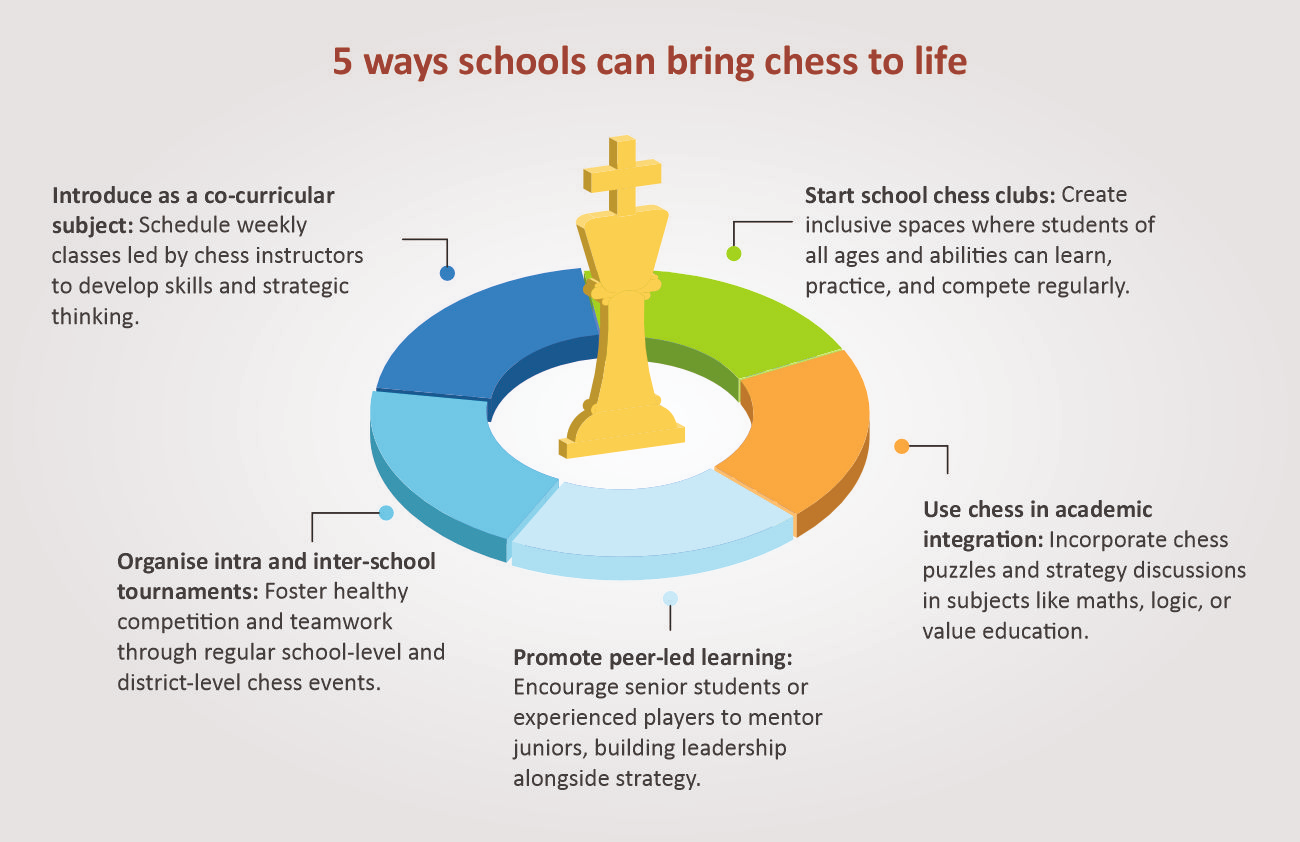
✅ 5 ways schools can bring chess to life

♟ Pawn to d4

             ♞ Knight to f6

                                         ♝ Bishop to g5One board |  32 pieces |  Unlimited thinking

Chess is beyond kings and queens; it is cause and effect in motion. It inspires students to analyse patterns, anticipate outcomes, and make thoughtful decisions. In a world that moves fast, chess offers a pause – creating space for clarity, calm reasoning, and critical thinking. Every game becomes a quiet exercise in strategy, patience, and perspective.

The rise of a thinking culture through chess

Can a board game truly become a powerful educational tool and shape the minds of an entire generation?

India, the birthplace of chess, originally called Chaturanga, is witnessing a resurgence in the classroom. From Gujarat’s government schools to private institutions in Bengaluru, chess for education is growing. Teachers and parents alike are realising the educational benefits of chess in helping students think better and feel more confident.


Thought break:

  •  Can a student anticipate the outcome of their actions three steps ahead?

That’s precisely what chess teaches – anticipation, sequencing, and foresight.


Backed by science: What the brain gains from chess

Chess is a full brain workout that activates both sides of the brain. While the left side handles logic and calculations, the right supports creativity and pattern recognition. Together, this mental balance further promotes chess and brain development.

In fact, according to the Chunks in Chess Memory paper, cognitive scientists estimate that some chess masters hold over 50,000 chunks, or common board patterns, in their memory. That’s how chess improves focus and concentration and sharpens long-term memory.
Moves that matter: How chess is powering progress

In India and around the world, chess has always been a powerful educational tool and continues to be a quiet force for change, strengthening focus and cultivating thoughtful learners.

  • Tamil Nadu leads the way: The state will soon be home to an exclusive chess academy, the “Home of Chess”, which will operate under the Sports Development Authority of Tamil Nadu.
  • Tripura’s young strategists take centre stage: In July 2022, Tripura hosted a U15 school chess tournament in Agartala, with 150 participants from tribal and rural schools, marking a strong push for chess in early education.
  • Victory in the virtual chess arena: In 2019, V.S. Rathanvel won the MPL Chess Mahayudh, India’s largest digital chess tournament, hosted by Mobile Premier League, which drew thousands of players, highlighting the boom in online chess.

Inclusivity on the chessboard

What’s more wonderful about chess is the fact that it transcends physical ability. Since its establishment in 1997, the All India Chess Federation for the Blind (AICFB) has enabled athletes with vision impairment to compete using tactile boards and voice-enabled tools.

One standout champion is Soundarya Kumar Pradhan, a para-athlete from Odisha, who has won multiple medals in major international events, including a silver at the World Junior Championship for the Blind in Poland (2018), gold at the IBCA World Team Championship (2022), and two medals at the Asian Para Games (2023).

For Soundarya and many like him, chess as a learning tool for kids boosts inclusivity and global representation.


Thought break:

  • Can a student stay composed when things go off plan?

Chess trains students to adapt without panic and re-evaluate under pressure.


Chess and the classroom: Where learning deepens

Communities across India are embracing chess, which is emerging as a catalyst for transformation. In July 2022, the Government Degree College, Khaltse (Ladakh), organised India’s first college-level chess event on International Chess Day, themed “Women in Chess”.

Meanwhile, the Odisha government is collaborating with FIDE to establish 100 chess centres and a fully funded chess academy, aimed at introducing strategic thinking and chess as a learning tool for kids across urban and rural communities.

VIBGYOR Group of Schools: Shaping young minds through chess

Across campuses, VIBGYOR Group of Schools has consistently recognised the value of chess as part of a well-rounded education. By integrating chess into school culture, we nurture analytical thinking, patience, and mental discipline in students.

VIBGYOR High Gurugram

In April 2025, the school hosted the Gurugram District Chess Championship, drawing enthusiastic participation across age groups. Organised by the District Chess Association, the tournament saw active participation across age groups and created a setting that encouraged strategic play and meaningful engagement. Backed by strong school leadership, the event reinforced the school’s role in promoting chess as a learning tool for kids, blending academics with real-world reasoning skills.

VIBGYOR Rise School, Nashik

On International Chess Day 2025, in collaboration with the Revolutionary Chess Club, the school hosted a large-scale chess tournament on campus. The event reflected the school’s focus on holistic education, combining physical, intellectual, and emotional development. With a modern learning space and an inclusive spirit, the tournament inspired strategic thinking, composure, and leadership in every participant, amplifying the school’s commitment to nurturing cognitive and personal growth.

The efforts of using chess in classrooms build curiosity, discipline, and foresight – encouraging young minds to think not just about moves, but also about meaning. Using chess to improve students’ analytical skills supports both academic and personal growth.


Thought break:

  • Does chess teach students to win with grace and lose with perspective?

Chess does both, quietly and consistently.


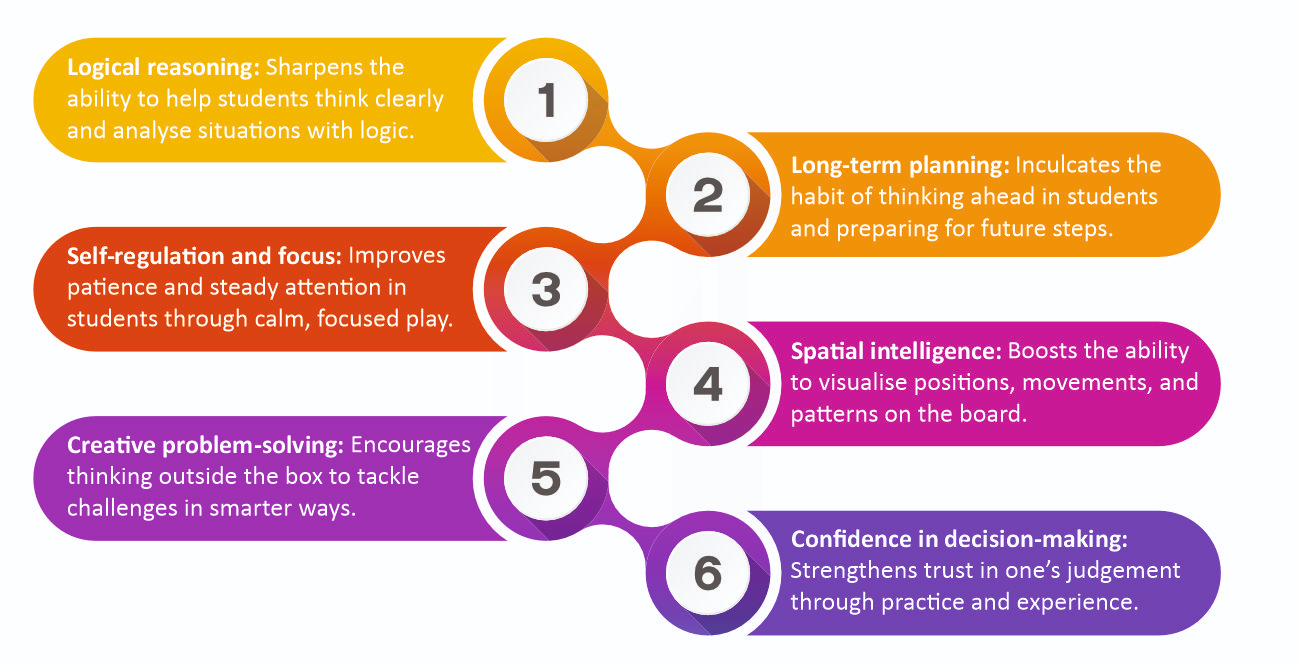
Skills that students build through chess

Chess for students’ mental skills goes beyond strategy and pieces. It nurtures essential abilities that shape sharper thinkers:
As a parent, you can support the journey by:

  • Encouraging chess not for competition, but for cognition.
  • Making it part of your child’s routine, just 15 minutes daily.
  • Using free, age-appropriate online platforms or joining local clubs.
  • Partnering with your school to advocate for using chess in classroom sessions.
  • Celebrating small wins, every small step is progress.

Chess for education encourages students to think ahead, stay calm under pressure, and respond with clarity. Its value lies in shaping sharper thinkers, compassionate leaders, and confident decision-makers. As this ancient Indian game finds new meaning in classrooms, communities, and competitions, it becomes a powerful educational tool for lifelong learning. Every move teaches intention, discipline, and reflection. For a generation growing up in a distracted world, chess offers something rare – quiet, focused growth.

The growing importance of incorporating soft skills training into academic curricula

Soft skills are vital in today’s world, equipping students with essential abilities like communication, teamwork, and emotional intelligence. India’s NEP 2020 emphasises integrating these skills into K-12 education. Schools are adopting holistic approaches, including experiential learning and technology, to develop well-rounded individuals. This transformation faces challenges but aims to build a future-ready generation.

Contributed By: Shim Mathew, Director of Academic Operations, Initiatives & International Partnerships, VIBGYOR Group of Schools

Soft skills have emerged as a cornerstone in the holistic development of individuals, especially in the 21st century, where emotional intelligence and interpersonal competencies often hold as much weight as technical expertise. While academic institutions have traditionally emphasised intellectual development and domain-specific knowledge, the growing demand from employers and society for well-rounded individuals underscores the necessity of incorporating soft skills training into academic curricula. This evolution is particularly pertinent in the Indian context, given the rapid transformation of the country into a global hub for diverse industries.
The National Education Policy (NEP) 2020 has placed a strong emphasis on developing well-rounded students. Its holistic vision includes fostering critical thinking, creativity, collaboration, and communication skills—all of which fall under the ambit of soft skills. Recognising these competencies as integral to preparing students for future challenges, the policy advocates for a paradigm shift in the education system, aligning it with global standards and local aspirations.

Why are soft skills crucial in today’s world?
Soft skills encompass a wide array of interpersonal and emotional abilities, such as communication, teamwork, adaptability, problem-solving, and emotional intelligence. These skills are indispensable in navigating today’s interconnected and multicultural world. According to LinkedIn’s Global Talent Trends report, 92% of talent acquisition professionals indicated that soft skills are equally or more important than hard skills. Additionally, a study by Harvard University, the Carnegie Foundation, and Stanford Research Center concluded that 85% of job success comes from having well-developed soft skills. Furthermore, the World Economic Forum’s Future of Jobs Report 2023 identified skills such as analytical thinking, creative thinking, flexibility and agility, active learning, and resilience as crucial for the evolving job market.
Show MoreBeyond employability, soft skills play a significant role in personal development. Effective communication, for instance, enhances relationships, while problem-solving skills empower individuals to tackle life’s complexities. Emotional intelligence fosters empathy and self-awareness, qualities that are essential in fostering harmony in diverse societies.

Integrating soft skills into K-12 curricula
The traditional K-12 education system has often been criticised for its rigid, exam-focused approach, which emphasises rote learning at the expense of critical thinking and creativity. Recognising this limitation, the NEP 2020 advocates for a transformative shift toward experiential and competency-based learning. Central to this vision is the integration of soft skills into the academic curriculum, fostering a more holistic and practical education framework.

This shift is not just theoretical. Many forward-thinking educational institutions are actively embedding soft skills training into their pedagogy, seamlessly blending these competencies with traditional subjects. Life skills programs have become an essential component of the curriculum, involving activities such as role-playing, storytelling, debates, elocutions, and collaborative projects that enhance students’ communication and interpersonal skills.

Moreover, leadership and teamwork are fostered through a variety of initiatives, including student councils, sports, and community service programs. Emotional intelligence is equally prioritised, with mindfulness practices, peer mentoring sessions, and workshops designed to build empathy and conflict resolution skills.

In addition to these academic reforms, schools are adopting a holistic approach to student development. Extracurricular activities, such as performing arts, STEM-based initiatives, and cultural clubs, encourage creativity and innovation, while personalised learning paths cater to diverse needs and interests, ensuring comprehensive personal and academic growth.

Technology serves as a powerful enabler in this transformation. Gamified learning platforms introduce engaging scenarios that enhance problem-solving and decision-making skills, while AI-driven feedback tools help students refine their communication abilities, including writing and public speaking. These advancements ensure that students are not only tech-savvy but also equipped with essential 21st-century skills.

As students advance, they receive career guidance and support for higher education, along with opportunities to engage in public speaking, internships, entrepreneurial projects, and real-world problem-solving tasks. These experiences help them develop practical skills essential for life beyond school. Furthermore, wellness programs and counselling services focus on promoting emotional and mental well-being. Together, these initiatives work to nurture students into confident, empathetic, and capable individuals, fully prepared to navigate the challenges of a dynamic world.

Challenges in implementation
While the incorporation of soft skills training into curricula is an admirable goal, it is not without challenges. One significant barrier is the lack of trained educators equipped to teach these skills effectively. Traditional teacher training programs often focus exclusively on subject matter expertise, leaving a gap in the pedagogical strategies needed for imparting soft skills. Addressing this requires investment in teacher development programs that prioritise holistic education.

Additionally, many schools face a lack of resources, including limited access to trained facilitators and the infrastructure necessary to support soft skills training. This shortage can hinder the consistent implementation of such programs, especially in underfunded or rural schools.

Societal perceptions also play a role. Many parents and stakeholders in the education system still equate academic success with high scores in science, mathematics, and other traditional subjects, often undervaluing the importance of soft skills. Creating awareness about the long-term benefits of these skills is essential for fostering acceptance and support.

Building a future-ready generation
The integration of soft skills into academic curricula is not merely a response to current trends but a proactive measure to prepare students for an uncertain future. In an era of rapid technological advancements and shifting societal norms, adaptability, resilience, and emotional intelligence are no longer optional; they are essential.

By aligning with the NEP 2020 and embracing innovative pedagogical approaches, educational institutions can bridge the gap between academic knowledge and real-world demands. The ripple effects of this transformation extend beyond individual success, contributing to the creation of a workforce that drives national progress and a society that thrives on mutual respect and collaboration.

Ultimately, the growing importance of soft skills training reflects a broader shift in education—one that values not just what students know, but who they are and how they interact with the world. As India continues to rise on the global stage, equipping its youth with these invaluable skills will be pivotal in shaping a brighter, more inclusive future.

The Joy of Puzzles: How Solving Mathematical Problems Enhances Cognitive Skills

Early years are crucial for brain development in children, and providing stimulating activities can significantly enhance their cognitive abilities. Research shows that about 90% of a child’s brain develops during early childhood. This makes it essential to engage children in activities that promote cognitive skills development and support their brain’s healthy growth. Math puzzles and mind games can significantly enhance brain development when paired with play, nutrition, and early education.

Research from the National Library of Medicine highlights a strong link between brain health and brain exercises like mathematical puzzles. These activities not only improve cognitive flexibility but also foster critical thinking, analytical skills, and problem-solving techniques. Moreover, mathematical puzzles make learning fun while strengthening cognitive skills and boosting logical reasoning.

Here’s how different types of math challenges for children can help sharpen their minds and strengthen their cognitive abilities.

Math Crossword

Math crosswords are like traditional word crosswords, but instead of letters, children fill in the grid with digits to solve vertical and horizontal calculations. Each blank square corresponds to a number, guided by mathematical clues. Starting with simple puzzles focused on one operation, like addition, builds confidence. As learners/students progress, multiple operations can be introduced, enhancing their arithmetic skills and critical thinking. Overall, math crosswords offer a fun and interactive way for children to practise math while engaging their minds.

Sudoku

Sudoku is a widely popular number puzzle that focuses on logical thinking. The puzzle requires filling a 9×9 grid so that each row, column, and 3×3 grid within the larger grid contains the digits 1–9 without repetition. Sudoku is ideal for school- going children as it stimulates their ability to spot patterns and apply logic. As they work through the puzzle, children

 learn to apply deduction and develop a systematic approach to problem-solving. Successfully completing a Sudoku puzzle not only boosts their confidence but also fosters a positive attitude toward math and challenges.

Math Riddles and Brain Teasers

Cognitive flexibility and puzzles go hand-in-hand, and math riddles are a great way to exercise that flexibility. You can easily create riddles from everyday scenarios, making them relatable and fun. For example:

The Multiplying Bricks:

A brick weighs 1 kg plus half a brick. What is the weight of a full brick?

Answer: 2 kg (Set up the equation: Brick = 1 kg + ½ Brick)

Age Riddle:

Aman is 5 years older than his brother. If the sum of their ages is 21, how old is Aman?

Answer: 13 (Brother is 8, Aman is 5 years older)

Crossing the River Puzzle:

A family needs to cross a river using a boat. The boat can carry only 2 people at a time. If there are 4 family members (2 adults and 2 children), how many trips will it take to get everyone across the river?

Answer: 5 trips (First trip: 1 adult + 1 child, Second Return Trip: 1 adult, Third Trip: 1 adult + 1 child, Fourth Return Trip: 1 adult, Fifth Trip: 2 adults)

The Magic Age:

Rohan is 8 years old. His father is 4 times his age. How old will his father be when Rohan is 16?

Answer: 40 years (Father is currently 32 years; when Rohan turns 16, 8 years will pass, making his father 40).

Vedic Math

Vedic Math is an ancient system of calculation techniques that simplifies complex mathematical problems through mental shortcuts. By using these innovative strategies, children can perform arithmetic operations more swiftly and with greater accuracy. This approach not only enhances computational skills but also nurtures logical reasoning and problem-solving abilities. As students learn to apply Vedic Math, they build confidence and develop a more positive attitude towards mathematics. This holistic method transforms traditional learning into an enjoyable and engaging experience, making math accessible for everyone.

Here are a couple of simple Vedic Math methods that can simplify calculations:

1. Multiplication by 11

Technique: To multiply a two-digit number by 11, add the two digits and place the sum in between them. If the sum is greater than 9, carry over the 1.

Example:

Multiply 34 by 11.

  1. Add the digits: 3 + 4 = 7.
  2. Place it in between 3 _ 7 4 → 374.
  3. Result: 34 × 11 = 374.

2. Squaring a Number Ending in 5

Technique: To square a two-digit number ending in 5, multiply the first digit by itself plus one, and append 25 at the end.

Example:

Square 75.

  1. Take the first digit (7) and multiply it by (7 + 1): 7 × 8 = 56.
  2. Append 25: 5625.
    Result: 75² = 5625.

Rubik’s Cube

The Rubik’s Cube is not just a colourful puzzle; it’s an excellent tool for enhancing spatial awareness and logical reasoning. As children manipulate the cube to find solutions, they engage in strategic planning and pattern recognition. The challenge of solving the Rubik’s Cube fosters perseverance as kids learn to tackle complex problems step by step. Moreover, this hands-on experience encourages patience and resilience, teaching them that success often requires repeated attempts and adjustments. By integrating fun with learning, the Rubik’s Cube cultivates a love for math and logic in a playful manner.

Finding Math Puzzles in Nature and Sports

Mathematics is everywhere, from the intricate patterns of nature to the strategies in sports, providing a rich landscape for engaging learners/students in learning. Observing mathematical concepts in the natural world like the symmetry of leaves or the spiral of shells helps children make real-world connections with what they learn in the classroom. Similarly, sports can introduce concepts like angles and trajectories, enhancing understanding through practical application. Children can also explore mathematical strategies like game theory to understand decision-making in competitive sports like chess, analysing the probability of certain moves or strategies for succeeding. Similarly, racing games can help children understand the concept of speed, time, and distance at a deeper level, By solving these puzzles, they develop critical thinking skills and an appreciation for the beauty of math in everyday life. This integration of math with nature and sports not only makes learning enjoyable but also demonstrates the relevance of mathematics beyond the classroom.

Abacus

The abacus makes mathematics exciting by turning numbers into a playful visual experience. With its simple bead movements, it helps learners/students grasp basic arithmetic quickly and fosters a love for numbers. The tactile nature of the abacus keeps children engaged, enhances memory retention, and strengthens their ability to perform mental math for simple calculations like addition, subtraction, multiplication and division. This interactive tool turns math lessons into fun exercises, making it easier for kids to understand the fundamental concepts.

Conclusion:

Engaging children in mathematical puzzles such as crosswords, Sudoku, and abacus exercises offers numerous benefits. These activities not only deepen their understanding of mathematical concepts but also cultivate essential skills applicable to real-life situations. By integrating such puzzles into your child’s daily routine, you lay a solid foundation for their mathematical journey, enhancing their ability to tackle everyday challenges with confidence.

As parents, providing positive reinforcement is vital. Celebrating every achievement, no matter how small, inspires children to persist in solving puzzles and broadening their mental horizons. By combining these mathematical challenges with a balanced routine of play, rest, and nutritious meals, you empower your child to develop into a confident and capable learner/student, ready to embrace more complex tasks with enthusiasm.

Also read our blog on Unlocking skills: The impact of playful learning on children’s development.


Top